What do AI visibility tools measure?
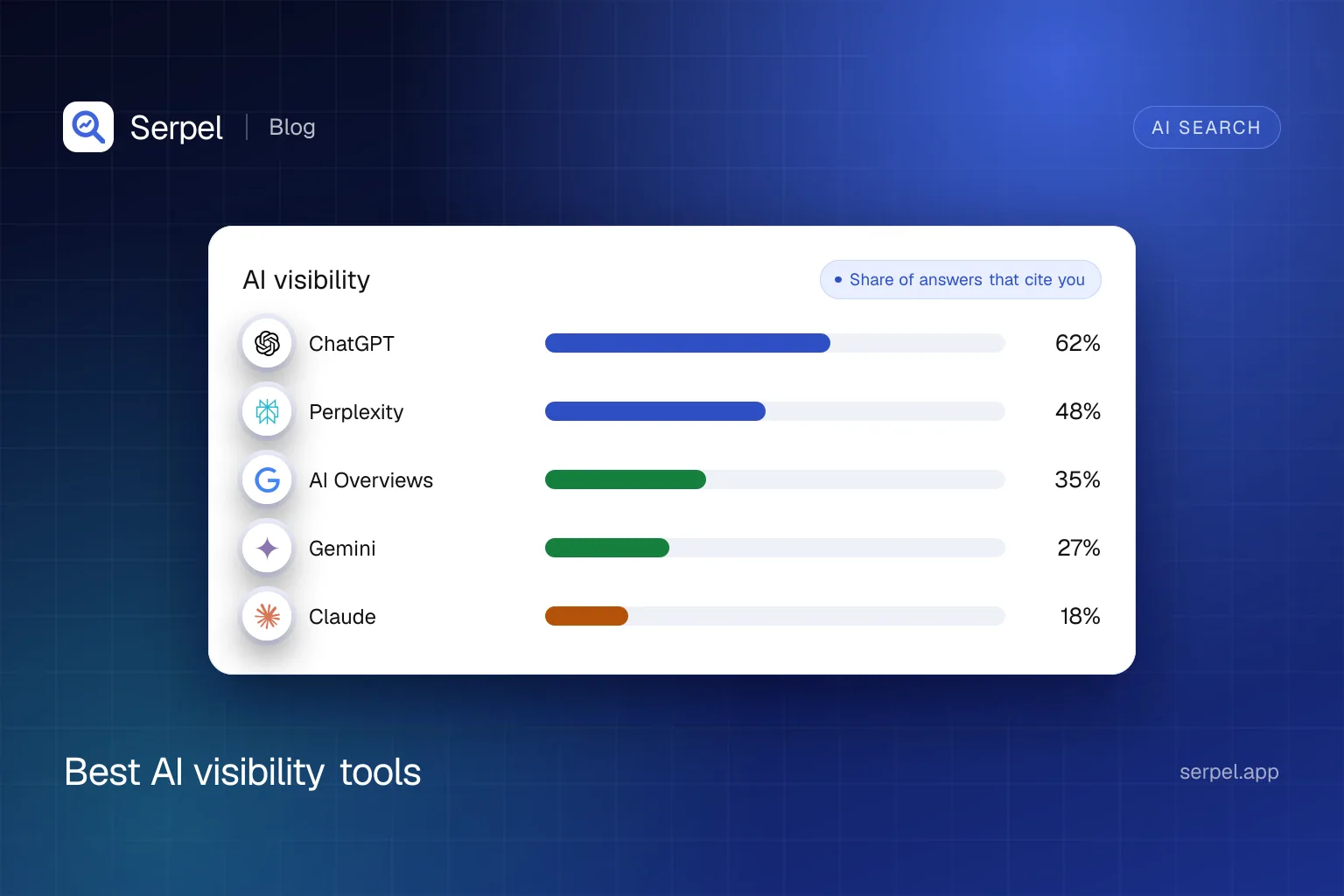
An AI visibility tool takes a list of prompts, which are the questions your customers ask AI assistants, runs them on one or more AI platforms on a schedule and records what comes back. From the answers it works out whether your brand is mentioned, whether your pages are cited as sources, which competitors appear instead and which websites the AI relies on.
Vendors use different names for the same ideas. Ahrefs defines mentions (your brand name appears in the answer text), citations (the answer links to your pages), AI share of voice and estimated impressions. Semrush adds an AI visibility score and brand sentiment. Whatever the names, the data is a sample of generated answers. Google points out that no third-party tool has access to its internal ranking or AI systems.
Answers also change from run to run. A July 2026 survey of GEO research reports that commercial audits found low source overlap and substantial run-to-run variability. For you that means a tool should repeat its checks and show a trend, not report one snapshot.
Which kinds of AI visibility tools exist?
- SEO suites with an AI add-on. Semrush and Ahrefs add AI tracking to their existing products. They suit teams that already work in those tools.
- Dedicated AI visibility platforms. Peec AI, Otterly.AI and Profound are built around AI answer tracking and usually cover more engines.
- Developer-first tools. Serpel exposes AI checks through a dashboard, CLI, API and MCP server, with pay-per-check pricing and a narrower scope.
- Free first-party reports. Google Search Console and Bing Webmaster Tools now report how often your pages appear in their own AI features.
Best AI visibility tools compared
The table lists what each vendor says it tracks and the pricing on its own public page on 10 Oct 2026. Prices are shown in euros as the pages displayed them, vary by region, and may differ in tax treatment and billing period, so treat them as a guide to scale rather than a quote.
| Tool | What it tracks | Public pricing | Notes |
|---|---|---|---|
| Semrush AI Visibility Toolkit | ChatGPT, Google’s AI features, Gemini and Perplexity, with visibility score, share of voice and sentiment | Base plan €94.94 per month per domain with 25 custom prompts. Enterprise on request | Extra domains, users and prompts cost extra |
| Ahrefs Brand Radar | ChatGPT, Perplexity, Gemini, Copilot, Google AI Overviews and AI Mode, plus Claude on custom prompts | Custom Prompts from €47 per month. AI Visibility Index from €179 per month | Usage is counted in checks. Paid Ahrefs plans include a small daily prompt quota |
| Peec AI | Three models of your choice from ChatGPT, AI Mode, AI Overviews, Copilot, Gemini and Naver AI. Extra models are paid add-ons | Starter €85 per month (50 prompts), Pro €205 (150), Advanced €425 (350). Enterprise on request | Unlimited users, daily tracking, 15% off annual billing |
| Otterly.AI | ChatGPT, Google AI Overviews, Perplexity and Copilot. Claude, AI Mode and Gemini are paid add-ons | Lite €29 per month (15 prompts), Standard €189 (100), Premium €489 (400). Enterprise from 1,000 prompts | Free trial. API and MCP access from the Standard plan |
| Profound | Trial: ChatGPT, Gemini and Google AI Overviews. Enterprise: up to nine answer engines, including Perplexity, AI Mode, Copilot, DeepSeek, Claude and Exa | Free trial with 50 prompts run daily for 7 days. Enterprise pricing on request | API and exports are listed for enterprise only |
| Serpel | ChatGPT with web search and Google AI Overviews only | 2 credits (€0.02) per prompt on ChatGPT and 2 credits (€0.02) on AI Overviews. 100 start credits, then Starter at €19 or Pro at €49 per month | 10, 25 or 50 prompts per project depending on the plan. Dashboard, CLI and API on every plan |
Where does each tool fit best?
- Semrush. A natural fit if your team already works in Semrush. The Base plan includes Brand Performance analysis for one domain and 25 prompts, so several brands or markets need extra domains or an enterprise plan.
- Ahrefs Brand Radar. Lists six platforms and two modes: Custom Prompts, where you choose the questions, and an AI Visibility Index modelled on more than 470 million prompts from Ahrefs’ keyword database. Ahrefs itself says the Index works best once your brand already appears in AI search.
- Peec AI. Pricing follows prompts and models rather than seats, with unlimited users on every plan. It also lists a crawlability audit that shows which AI bots your robots.txt allows or blocks.
- Otterly.AI. The lowest entry price in this list, which suits small teams that need a few prompts. Cost rises with prompts and with each extra engine you add.
- Profound. Aimed at companies running marketing agents at scale. Its self-serve option is a seven-day trial and full pricing is by quote, so you cannot compare its price publicly.
Where does Serpel fit, and where does it not?
Serpel’s scope is narrow. It checks ChatGPT with web search and Google AI Overviews and nothing else today: no Perplexity, Gemini, Claude, Copilot or Google AI Mode tracking, and no sentiment scoring. If your customers mainly use those platforms, a dedicated platform covers more ground.
What you get is a precise record of the two surfaces it covers. Add prompts to a project, run them on demand and see for each one whether ChatGPT’s answer cited your domain (linked a page of yours) or only mentioned it, together with the answer’s sources and the history over time. Serpel also shows which domains are cited most often in answers, with yours highlighted, whether Google showed an AI Overview for your tracked keywords and cited you, and, from your last site crawl, which AI crawlers your robots.txt allows and whether an llms.txt file is reachable.
Serpel bills each check in credits. A credit is worth €0.01 at list price, so checking 25 prompts on both surfaces costs €1.00. The dashboard, CLI and API read the same data, so a CI job or a coding agent can run the checks and read the results. See AI visibility in Serpel and the pricing page for the current numbers. The limits to know are 50 prompts per project on the largest plan and two AI surfaces.
How do you choose an AI visibility tool?
- Start from your audience. Track the AI products your customers actually use. Paying for nine engines is wasteful if two of them matter.
- Count prompts, markets and engines. Cost grows with each. Peec AI says its pricing is based on tracked prompts and models, and Ahrefs counts one check per prompt, platform, location and update.
- Check how often it repeats. Daily or weekly runs give you a trend. A single snapshot is noisy because answers vary between runs.
- Look at data access. If you want results in dashboards, CI or an agent, check for an API, exports or MCP. Otterly.AI lists API and MCP access from its Standard plan, Profound lists API and exports for enterprise, and Serpel offers the dashboard, CLI and API on every plan.
- Compare pricing models. Flat plans suit steady tracking. Per-check credits suit occasional audits and agent-driven workflows.
- Ask how answers are collected. Which country and language does the tool use, is web search on, and how often is a prompt re-run? A reproducible method matters more than a polished dashboard.
Can you track AI visibility for free?
Partly. Two first-party reports are free. Search Console’s Generative AI performance report shows impressions in AI Overviews and AI Mode by page, country and device, and Google says it rolled out to all sites worldwide on 31 Aug 2026. Bing Webmaster Tools’ AI Performance report shows citation counts and cited pages for Copilot and AI summaries in Bing, in public preview. Neither covers ChatGPT.
For ChatGPT you can test prompts by hand: turn on search, ask your questions, open the sources and note whether your domain appears. That works for a handful of prompts and stops scaling quickly, which is where paid tools earn their price. Our guide on how to rank in ChatGPT explains the manual check in detail, and the generative engine optimization guide covers what to change once you have a baseline.
Frequently asked questions
What is an AI visibility tool?
An AI visibility tool runs a list of prompts on AI platforms such as ChatGPT, Google’s AI Overviews and Perplexity, and records whether your brand is mentioned or your pages are cited. Most also show which sources the AI relies on and how you compare with competitors. They sample generated answers, so results vary between runs.
How much do AI visibility tools cost?
On the public price lists checked on 10 Oct 2026, entry plans started at €29 per month for 15 prompts at Otterly.AI, €47 per month for Ahrefs Brand Radar custom prompts, €85 per month at Peec AI and €94.94 per month per domain at Semrush. Profound sells by quote, and Serpel charges per check. Costs rise with the number of prompts, engines and markets.
Do I need a paid tool to track ChatGPT and Google AI Overviews?
Not to start. Search Console’s Generative AI performance report and Bing’s AI Performance report are free, and you can test ChatGPT prompts by hand. A paid tool becomes worthwhile when you track many prompts, need history, or want the data in a dashboard, API or coding agent.
Which AI platforms should an AI visibility tool cover?
The ones your customers use to ask questions. For most sites that means ChatGPT and Google’s AI features first, then Perplexity, Gemini, Copilot or Claude if your audience uses them. Check the vendor’s platform list before you pay, because coverage differs a lot between tools.
Sources
- Semrush: AI Visibility Toolkit pricing, accessed 10 Oct 2026
- Semrush Help: AI Visibility Toolkit, accessed 10 Oct 2026
- Ahrefs: Brand Radar, accessed 10 Oct 2026
- Peec AI: Pricing, accessed 10 Oct 2026
- Otterly.AI: Pricing, accessed 10 Oct 2026
- Profound: Pricing, accessed 10 Oct 2026
- Google Search Central: Optimizing your website for generative AI features on Google Search, accessed 10 Oct 2026
- Search Console Help: Generative AI performance report, accessed 10 Oct 2026
- Search Engine Journal: Bing Webmaster Tools adds AI citation performance data, accessed 10 Oct 2026
- Martinez, Optimizing Visibility in Generative Engines: A Critical Survey of Generative Engine Optimization (arXiv 2607.14035), accessed 10 Oct 2026
Related reading
- AI visibilitySerpel is an AI visibility tool: it checks whether ChatGPT and Google AI Overviews cite your website for the questions your customers ask.
- Generative engine optimization (GEO): what it is and what worksGenerative engine optimization (GEO) is how you get cited in AI answers. See what the research found, what Google says and a checklist you can use.
- SEO for ChatGPT: how to rank in ChatGPT search and get citedSEO for ChatGPT means letting OAI-SearchBot in and being quotable. How ChatGPT search picks sources, what to do and how to check citations.
- Peec AI alternativeA Peec AI alternative for developers: compare Serpel and Peec AI on pricing, AI platforms, prompts, API and MCP, with sources and dates.